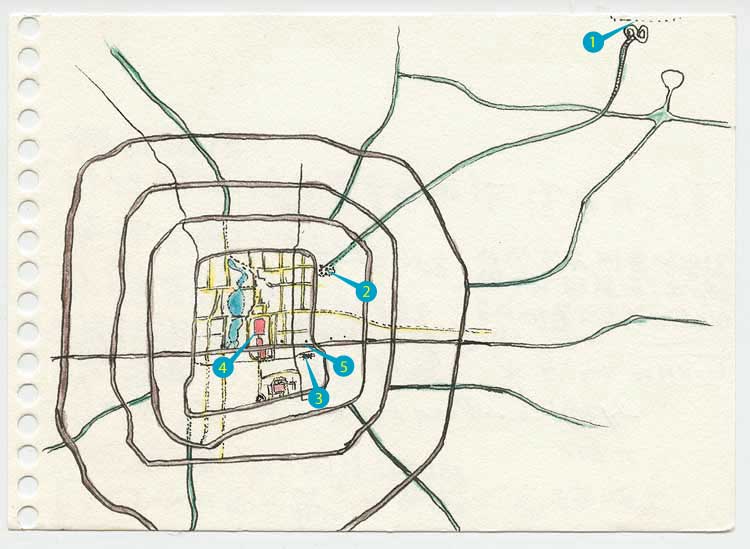
北京Beijing has a long history. Ignoring its prehistoric beginnings, its prominence within Chinese civilization can be traced back about 3000 years to the
春秋战国Spring and Autumn Warring States Era (about 770
BCE - 221
BCE), where the state of
蓟Ji established itself on present Beijing. Later, the the well-known state of
燕国Yan took over and it became its capital, then known as
燕京Yanjing or
燕都Yandu.
From the first dynasty
秦朝Qin (221
BCE - 206
BCE) onward it was treated with importance.
But it wasn't until the
元朝Yuan dynasty (1271-1368) that the Mongols made it a capital (then called
大都Dadu) of an empire. When
明朝Ming dynasty (1368-1644) drove out the Mongols, the chosen capital was
南京Nanjing (South Capital), and the Mongol capital was renamed
北平Beiping.
But after
朱棣Zhudi (the fourth son of the Ming founder) took over the throne by force, he had Beiping renamed to
北京Beijing (North Capital), and moved his court there inside the new palace, which is the present
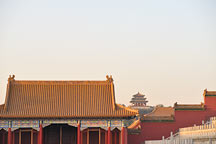
故宫Gugong (Palace Museum or Forbidden City). Beijing remained the capital through the
清朝Qing Dynasty (1644-1911). However, during the latter half of the
民国Republican Era (1912-1949),
Nanjing became the capital again while Beijing was reverted back to its early Ming name, Beiping. With the establishment of
中华人民共和国People's Republic Of China, Beijing regain its long-standing position.
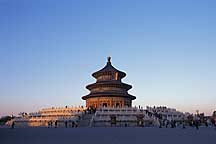
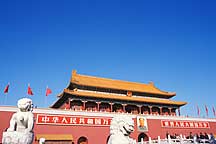
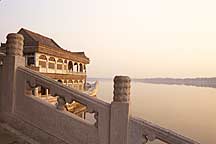
With the rare luck of being the host of successive emperors and more than 700 years of imperial heritage, Beijing easily surpasses others as the political and cultural hub of China. The ancient city has alot to offer: the great imperial palace and gardens, the magnificent temples, the large square, the Great Wall, the operas, the museums, the hutongs, the hills and lakes, the food and many others. All of which are world-class. The several times I had returned to China, I had visited this city. It is a big diverse place that takes time to know.
 KingWong.com
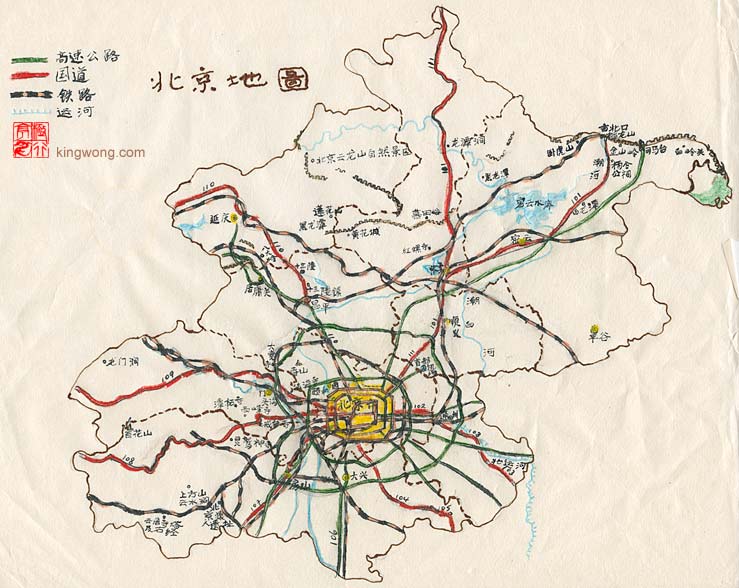
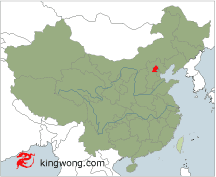
 北京地图Map of Beijing
 长城地图Map of Great Wall
 长江地图Map of Changjiang River
 安徽地图Map of Anhui
 甘肃地图Map of Gansu
 河北地图Map of Hebei
 湖北地图Map of Hubei
 湖南地图Map of Hunan
 江苏地图Map of Jiangsu
 内蒙古地图Map of Neimenggu
 宁夏地图Map of Ningxia
 陕西地图Map of Shaanxi
 上海地图Map of Shanghai
 山西地图Map of Shanxi
 新疆地图Map of Xinjiang